
Environmental Education and Awareness is a key program for the African Centre for Environmental Protection that protects the environment and promotes sustainable development. By integrating environmental education into formal and informal learning systems, we empower individuals and communities to adopt sustainable lifestyles and make informed decisions about the environment.
Our strategies for promoting environmental education and awareness include;
The focus of ACEP is to promote circular economy/natural resource conservation to reduce greenhouse gas emissions and house gas emissions, reduce energy consumption, and promote renewable energy sources. A circular economy is a regenerative system that aims to keep resources in use for as long as possible.
To actively ensure the reduction of the impact of climate change on the environment, we design and implement programs that focus on protecting our depleting natural resources. Some of these programs include;
When properly understood, environmental education (E.E.) constitutes a comprehensive lifelong education responsive to changes in a rapidly changing world. It should prepare the individual for life by understanding the contemporary world’s significant problems and providing skills and attributes needed to play a productive role towards improving life and protecting the environment through ethical values (UNESCO, 1977).
CLT is an approach in which people in rural communities are facilitated to appraise and analyse the sanitation situation, conclude, and take action. Community-led total sanitation (CLTS) is the most effective means for reducing chronic and absolute poverty and intergenerational income inequalities. The policies and programmes for CLTS centre on better sanitation, a clean environment, ODF (Open-Defecation-Free), good/safe drinking water, mother and childcare, etc., and all these have direct positive and negative impacts on the health and well-being of the people. Community Total Sanitation creates a sustainable development scope geared towards curbing future occurrences in places with a sudden population increase.
We specialize in creating Sustainable enterprises which employs profitable strategies that approach social and environmental challenges as business opportunities. The success of every sustainable enterprise is measured in terms of a triple bottom line.
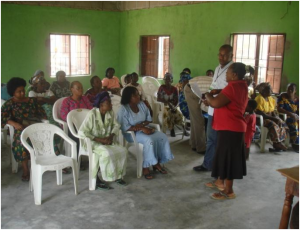
The table below highlights some of our achievements:
| S/n | Project | Funder |
|---|---|---|
| 1 | Community Development Planning and NEEDS Framework documentation in Ogu-Bolo community, Rivers State | Rivers state Sustainable Development Agency (RSSDA) |
| 2 | Primary Environmental awareness raising programme for 18 secondary schools in Rivers State. | Rivers state Sustainable Development Agency (RSSDA) |
| 3 | Natural Resource Conservation-Tree planting scheme in Schools in Egi Community | TEPNG |
| 4 | Riv-Green awareness campaign Project on PEC and set up Riv-Green clubs in 46 secondary schools across Rivers State | Rivers State Ministry of Environment |
| 5 | Primary Environmental Care (PEC)/Resource Conservation in secondary schools in Egi Land.Establishment and monitoring of Conservation Clubs | TEPNG |
| 6 | Community Led Total Sanitation,awareness raising and training on proper waste Management | TEPNG |
| 7 | Environmental Competitions: ACEP anchored the Annual EnvironmentalProgram | Moni- Pulo Nigerian Oil Company |
| 8 | Awareness raising on water supply and sanitation. | Rivers State Ministry of Water Resources |
| 9 | World Environment Day (WED) Celebration Conservation club set up/monitoring in schools in Rivers State. | Rivers State Waste Management Authority (RIWAMA), Rivers State Ministry of Education, HeRock Nigeria Limited |
| 10 | Promoting Health State – Citizen Relations in Africa. | SFCG, USAID |
African Centre for Environmental Protection (ACEP) is a not-for-profit Non-Governmental Organization based in the Niger Delta Region.
